what causes the inside of the cell to be more negative compared to the outside of the cell quizlet
Lights, Camera, Action Potential
 This page describes how neurons work. I hope this explanation does not go as well complicated, but it is important to understand how neurons do what they do. There are many details, but go slow and expect at the figures.
 Much of what we know about how neurons piece of work comes from experiments on the giant axon of the squid. This giant axon extends from the head to the tail of the squid and is used to help the squid motion. How giant is this axon? Information technology can be up to 1 mm in diameter - piece of cake to see with the naked eye.
Neurons send messages electrochemically. This means that chemicals crusade an electrical signal. Chemicals in the torso are "electrically-charged" -- when they accept an electrical charge, they are called ions. The important ions in the nervous system are sodium and potassium (both accept i positive charge, +), calcium (has ii positive charges, ++) and chloride (has a negative charge, -). At that place are also some negatively charged protein molecules. It is also of import to call up that nerve cells are surrounded past a membrane that allows some ions to laissez passer through and blocks the passage of other ions. This type of membrane is chosen semi-permeable.
Resting Membrane Potential
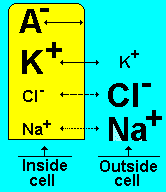 When a neuron is not sending a signal, it is "at residual." When a neuron is at rest, the inside of the neuron is negative relative to the outside. Although the concentrations of the different ions attempt to balance out on both sides of the membrane, they cannot because the cell membrane allows only some ions to laissez passer through channels (ion channels). At rest, potassium ions (One thousand+) can cantankerous through the membrane easily. Likewise at rest, chloride ions (Cl-) and sodium ions (Na+) have a more difficult fourth dimension crossing. The negatively charged poly peptide molecules (A-) within the neuron cannot cross the membrane.
 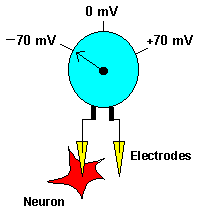 In addition to these selective ion channels, at that place is a pump that uses energy to move iii sodium ions out of the neuron for every ii potassium ions it puts in. Finally, when all these forces balance out, and the difference in the voltage between the inside and exterior of the neuron is measured, you have the resting potential. The resting membrane potential of a neuron is about -70 mV (mV=millivolt) - this means that the inside of the neuron is 70 mV less than the outside. At rest, in that location are relatively more than sodium ions exterior the neuron and more potassium ions inside that neuron.
Activeness Potential
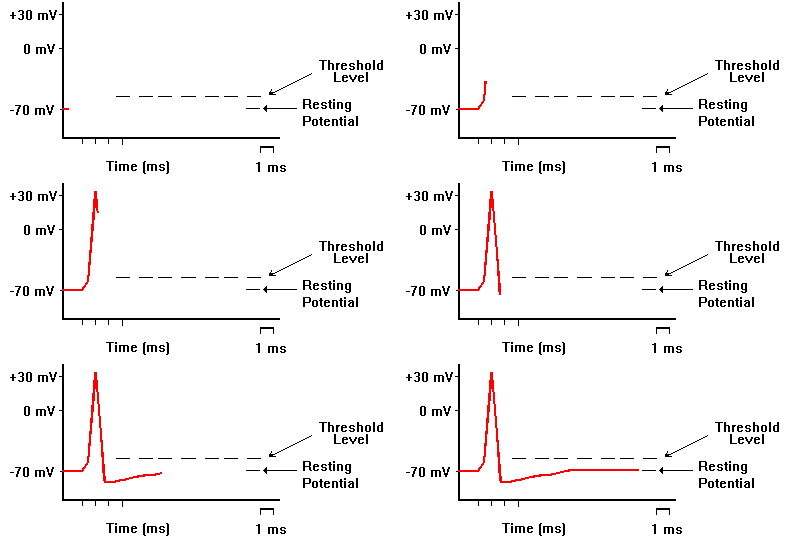
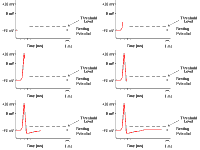
The resting potential tells near what happens when a neuron is at residuum. An action potential occurs when a neuron sends data downward an axon, abroad from the prison cell body. Neuroscientists use other words, such as a "spike" or an "impulse" for the action potential. The action potential is an explosion of electrical activity that is created by a depolarizing current. This means that some event (a stimulus) causes the resting potential to move toward 0 mV. When the depolarization reaches virtually -55 mV a neuron volition fire an activity potential. This is the threshold. If the neuron does non reach this disquisitional threshold level, then no action potential will fire. Too, when the threshold level is reached, an action potential of a stock-still sized volition ever fire...for any given neuron, the size of the action potential is always the same. There are no big or small action potentials in one nerve cell - all action potentials are the same size. Therefore, the neuron either does not accomplish the threshold or a full activeness potential is fired - this is the "ALL OR NONE" principle.
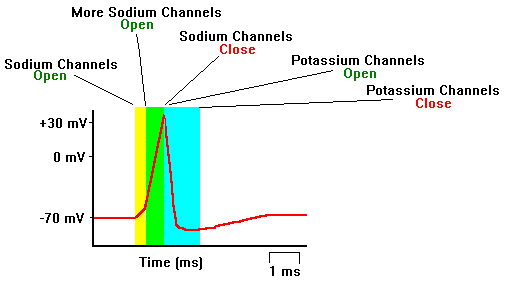 Action potentials are caused when different ions cross the neuron membrane. A stimulus showtime causes sodium channels to open up. Because there are many more sodium ions on the exterior, and the within of the neuron is negative relative to the outside, sodium ions rush into the neuron. Recollect, sodium has a positive charge, then the neuron becomes more positive and becomes depolarized. Information technology takes longer for potassium channels to open. When they practice open, potassium rushes out of the cell, reversing the depolarization. Likewise at nearly this fourth dimension, sodium channels start to shut. This causes the activity potential to get back toward -70 mV (a repolarization). The action potential actually goes past -seventy mV (a hyperpolarization) because the potassium channels stay open a bit too long. Gradually, the ion concentrations become back to resting levels and the cell returns to -70 mV.
And in that location you lot have it...the Action Potential
| Did you lot know? | The giant axon of the squid can exist 100 to thou times larger than a mammalian axon. The behemothic axon innervates the squid's mantle muscle. These muscles are used to propel the squid through the water. |
Copyright © 1996-2020, Eric H. Chudler All Rights Reserved.
Source: https://faculty.washington.edu/chudler/ap.html

Post a Comment for "what causes the inside of the cell to be more negative compared to the outside of the cell quizlet"