Envisiontec Vida 3d Printer Dental Lab Equipment for Laboratory Procedures Reviews
Marking McInnis, DMD, shares the lessons he's learned while building a digital do incorporating the latest 3D printing technology and aligner planning software
By Alison Werner | Photography by Carl Ackerman
Implementing an intraoral scanner into the orthodontic practice opens up a world of possibilities. For South Carolina-based orthodontist Mark McInnis, DMD, it led to the purchase of a 3D printer and manufacturing aligners in-office. But more than anything, information technology put his do at the forefront of the digital development of orthodontics.
3 years ago, when McInnis prepare out to comprise 3D printing into his Clemson, SC, exercise, Upstate Orthodontics, he knew he wanted to ease into it and avert stressing his staff and disrupting their workflow. Then, he opted for a relatively inexpensive, entry level consumer-grade printer that they all could learn on. They started, like most practices, with making retainers, fifty-fifty though that was not McInnis' ultimate goal.
Over the grade of a year, that outset printer taught him some valuable lessons. While it made good fitting retainers and aligners, it had its fair share of issues. First, it was wearisome and unpredictable. Second, it lacked a skillful customer support system. When McInnis was set up to ramp up his in-part aligner offerings, he had two options: invest in his own print subcontract with multiple lower-cost printers or invest in a commercial-grade printer.
McInnis opted for the commercial-course printer and purchased an EnvisionTEC Vida printer from 365 Printing at the American Association of Orthodontists (AAO) Annual Session in Washington, DC in 2018. As McInnis puts it, the DLP printer was a solid workhorse, but information technology was the customer service that came with information technology that swayed him. 365 Press offers both in-office preparation and ongoing customer support. That peace of mind is key, says McInnis. "I don't have to endeavour and figure it out on my own. That safe cyberspace is huge."
The Software Component
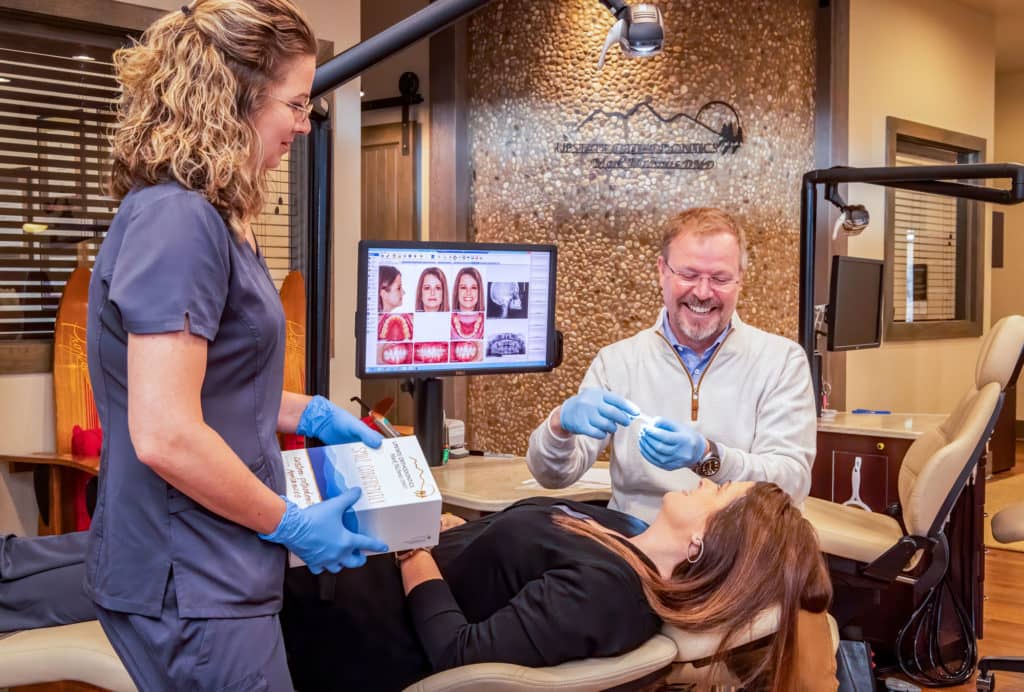
While at the same meeting in DC, McInnis also finagled his manner into the pilot study group for uLab System's aligner treatment planning software. McInnis made a point of demoing all the software options at that evidence and what attracted him to the uLab software was its simplicity and the automation. "Information technology's like using a Mac or iPhone versus a PC," he shares. "Information technology'south very intuitive." At that signal, the software already featured a number of automatic processes, including tooth selection and alignment.
Since then, the automation inside the uLab software has expanded to the 3D press workflow. STL files are automatically labeled, trimmed, and exported to the printer. Exported files are then automatically arranged in the print tray. The software is compatible with the leading printers and thermoformers, and with the uContour characteristic can be automatically trimmed. The software also allows for aforementioned-day treatment starts and combination handling, and includes advanced AI technology that will learn and apply the user'due south preferences over time. uLab too provides the resources need to make aligners.
McInnis has watched the software change over the last 2 years and welcomes the new tools uLab Systems has rolled out, including the retouch feature which allows the orthodontist to rescan a patient mid-treatment and not create a whole new treatment plan. Instead, the software marries the new paradigm with the original scan to determine that patient'due south electric current status, and then calculates where the terminal plan needs to go based off the original set. "The retouch feature just allows yous to save all that time on having to rebuild your case. Even when yous pay an outside lab to do that, yous by and large terminate upwards having to tweak it…and frequently have to bounciness back and forth with the technician. When you practise them yourself, you lot can just sit down down and knock it out completely just once," he says.
As a member of the pilot study group, McInnis has witnessed the software'southward evolution and has been impressed with the speed with which the developers have taken on feedback and adapted the platform. "They're very open to feedback from their users so adapting those good ideas into their platform, which is so refreshing," says McInnis, who was too a beta user of Dolphin's practice management software.
Time to Upgrade Printers
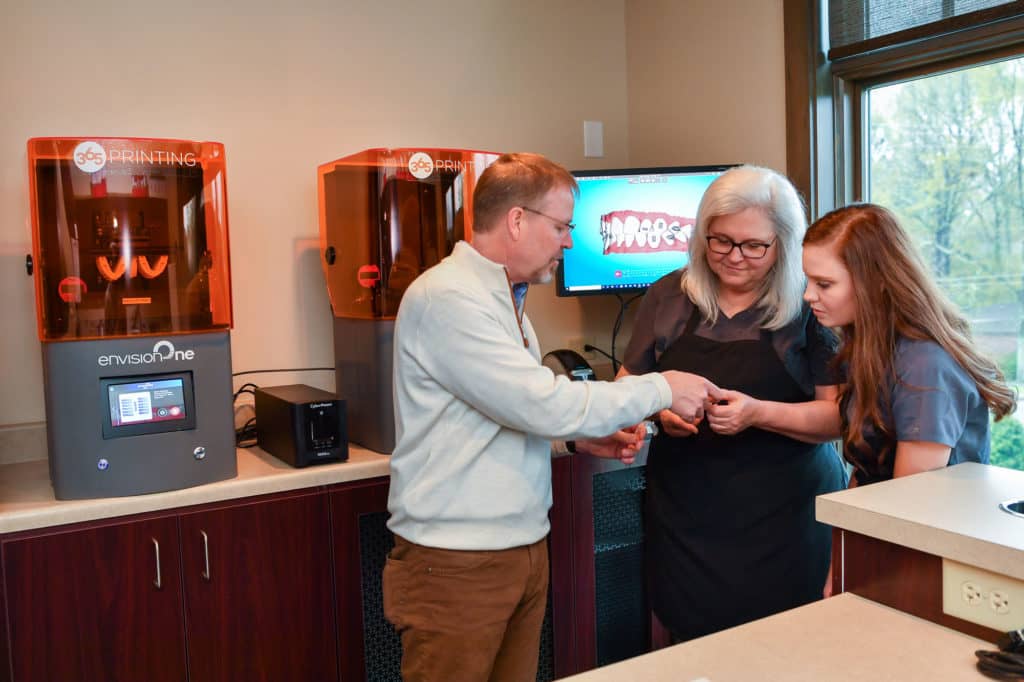
A twelvemonth ago, McInnis decided it was fourth dimension to upgrade his printer. With the uLab software, efficiency and productivity had increased. The volume of models his in-office lab was producing necessitated a faster printer. He opted for 365 Printing's newest model—the EnvisionOne. He'd first seen the printer in action at a study club meeting. Using CDLM technology, the commercial-grade desktop printer's speed and consistency impressed McInnis. With the EnvisionOne, McInnis' practice is able to print xviii to 20 models vertically in a little over an hour. Why print vertically? As McInnis puts it, this orientation allows the user to print hollow, reducing resin waste and saving money. Moreover, information technology allows for self-draining and easier removal of the model. Another more important reward: Users can print more models per impress task. Equally the visitor puts it, vertical printing allows for a better workflow. Batching for larger print jobs can reduce estimator time and post-processing time by lxxx%. McInnis was also fatigued to the EnvisionOne's reported accuracy when press vertically, as this is ofttimes compromised with this orientation. Co-ordinate to 365 Printing, preliminary testing shows that press vertically on the EnvisionOne is less than 1% quality difference than printing horizontally. After nigh a year of utilize, McInnis has not had any problems with aligner fit.
Somewhen, McInnis decided to purchase a second EnvisionTEC One printer to ensure redundancy. "I believe redundancy is something that we need in our practices. It is a piece of equipment. It can go downwards. If it does go down, you lot need a backup. Fifty-fifty though I take enough customer support, I really felt the need to take two identical printers." And the fact that he has chosen two identical printers is key. "I run across a lot of practices in the Facebook groups talking about all the unlike printers they have. Having had dissimilar printers, the problem you lot run into is they employ unlike software. When y'all become and build a print task on one printer, the next printer may be open, just you lot can't send it to that ane to print considering you have to await for the printer you built it for to open upwards to exist able to print."
When it comes down to specs, speed, accuracy, and cost-effectiveness are the key metrics by which to judge a printer. While it would be swell to find all three in i printer, the reality, says McInnis, is that you're only likely to get 2 out of iii. "You typically make a sacrifice. If you get a cheap printer, it'southward not going to be fast and accurate. There's going to be a compromise and you're going to have to brand a choice which is more than important to you."
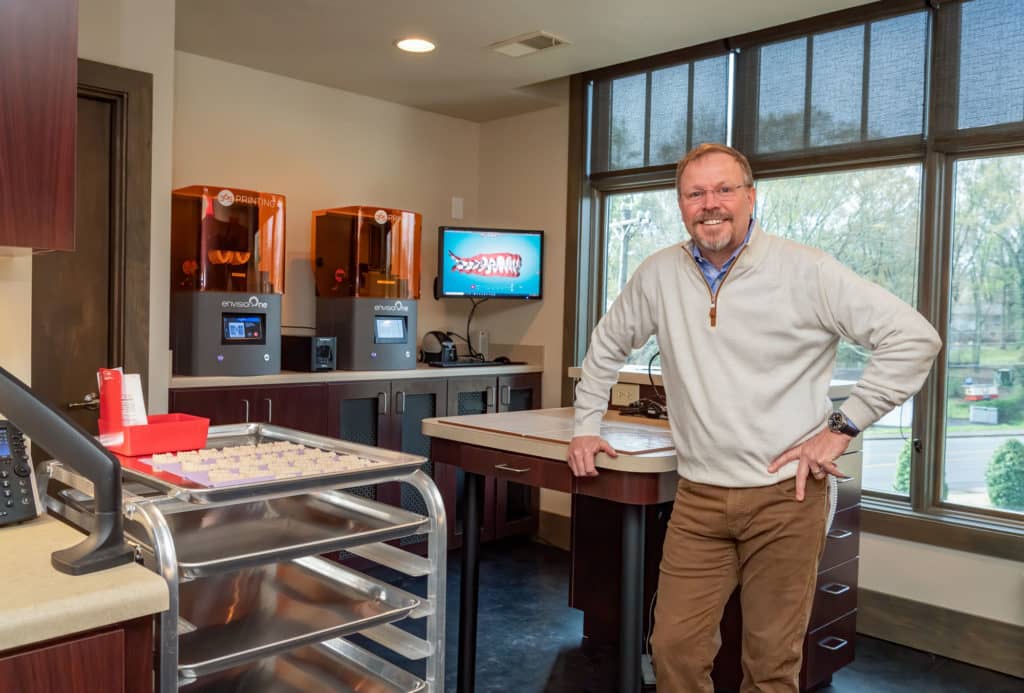
With regard to lab space, like virtually orthodontic practices, McInnis did not build the lab at his main location five years ago with 3D applied science in mind. While his ventilation organisation was already equipped to handle the 3D press functioning, he did reconfigure a couple of outlets and invest in a bombardment pack surge protector to protect the printers and the prints jobs if the power cuts off and on. And he did pull out cabinetry when he brought in the taller EnvisionOne unit and has remodeled his lab here and in that location to get the right configuration for the virtually efficient workflow.
Taking Control of Aligners
McInnis, a graduate of the Medical University of South Carolina, who completed his orthodontic residency at the University of Missouri, Kansas City in 1998, was part of that starting time wave of orthodontists working with Invisalign when information technology launched. Initially, cases weren't as successful as he would have liked. The combination of PVS impressions, materials, and inadequate attachments kept McInnis turning to stock-still appliances. Simply about five years ago, his stance inverse equally he saw how other orthodontists were pushing the modality's limits beyond what he considered possible. What's more than, he saw a treatment modality that could assistance eliminate the decalcification and other hygiene issues that come with fixed appliances. From there, he dug into the biomechanics and realized he could get the results he craved with aligners.
Aligners, and a digital orthodontic workflow overall, allow McInnis to significantly reduce the number of follow-up appointments necessary. This translates into higher revenue for the practice fifty-fifty though the material price of treating a fixed appliance patient is lower.
"Braces themselves are cheaper than say aligners, merely you lot end up seeing the patient almost twice every bit much. [With aligners,] y'all can treat a patient with a more than expensive lab bill and withal come out ahead because you're going to come across them fewer times in your office," he points out.
Today, the practice is evenly split between aligner and fixed appliance cases when it comes to new starts.
McInnis started offering in-office aligners over a year ago, giving patients a more than affordable option and reducing his lab costs. Most labs accept a fixed fee, regardless of the number of aligners printed, and they frequently require the full lab fee upfront. Equally patient downwards payments are typically lower than the lab fee, it's often months earlier the practise breaks fifty-fifty and sees whatsoever profit—a concept McInnis never loved.
"With in-office aligners, my initial cost is solely related to the aligners that I fabricate. My costs for producing those aligners are spread out over a longer period of time," says McInnis, who offers patients the choice betwixt braces and aligners, and then betwixt in-office aligners or Invisalign. The patient chooses, but McInnis is able to offer a lower down payment with in-function aligners because of the pricing construction as it relates to the lab beak. McInnis opts to print smaller aligner orders in house, leaving the larger orders to exterior labs.
At present in terms of costs, McInnis is quick to dispel the idea that the cost of the 3D printer should be the barrier to printing in-role aligners. Often, he hears colleagues cite the $viii,000-$15,000 cost of a printer as the reason they can't possibly get into in-role aligners, while at the same time they didn't bat an eye at a $150,000 x-ray machine or a $thirty,000 intraoral scanner. "You evidently make choices based on a number of factors, but don't await at the cost as the large deterrence because where there are more expensive things that you utilise in your practise on a daily basis. This particular one will let you to generate a different acquirement stream," he points out. For McInnis, labor is the largest expense, non his 3D printer. Currently, he has ii-full time lab techs.
For those who do make up one's mind to make the plunge, McInnis cautions against the upkeep printers. Aye, the upfront costs and resin costs may be less, but there's a merchandise off in terms of accuracy, reliability, and staff time. "Having consistency of workflow and dependability of a commercial auto was the management that I went," says McInnis, who next plans to expand into printing indirect bonding trays. "Ultimately, I was trying to have something that would cut down on staff time considering labor amounts to one-third the cost of the aligner," while the printer price averages about 50 cents per aligner in his practice. His in-office lab fabricates on average 110 aligners per day.


According to McInnis, the maximum number of aligners the practice produces and delivers to a patient at whatever once is 12 upper and 12 lower aligners. And in that location's a reason for that.
"When you apply Invisalign, they ship you all of your aligners for the whole case upfront. Nosotros typically will deliver all those to the patients, so we don't have them in the part. Simply there's quite a few patients that will accept a tracking error. You may try to but get through the aligners that you have before you rescan them, but as tracking errors happen…fit issues go more of an consequence, and then your level of command goes out the window," he explains.
"Well, if you have an Invisalign instance, you may simply keep pushing through those aligners or yous may fix upwardly a refinement browse. On occasion, you may accept to throw out a good number of aligners. If you're making them in house, you don't have to make all of them upfront. I typically will make 12 and encounter the patient dorsum in 10 weeks to evaluate the fit of the aligners. If they fit properly, we'll go ahead and impress the remainder of them, and the patient can only choice them upwardly at the front desk. But if nosotros do have a fit issue, where we're starting to go a tracking error, so instead of going ahead and making the balance of the aligners and having a poor return on investment or not getting as high a percentage out of the move that we programed in, we will reschedule them dorsum in two weeks for a refinement scan and redo the instance. At that point in time, they'll accept proper fitting aligners and we don't end up having to throw away aligners because nosotros made them all upfront. We are able to mitigate that because we can turn them around so much faster."
The instance control and revenue potential of an in-office 3D printing performance is evident, but that's not to say that there aren't hurdles that can't exist ignored, says McInnis, but they are surmountable. Whether it be mastering a new software and learning how to set up and phase your own cases or learning digital production and how to calibration that upwardly, the payoff is there for the taking. Information technology just requires flexibility and an openness to learning a new workflow that will conduct the practice forward.OP
LEARN More than: CHECK OUT OUR VIDEO INTERVIEW WITH DR Marker MCINNIS.
Source: https://orthodonticproductsonline.com/practice-management/practice-profiles/profile-mark-mcinnis-in-office-aligners-3d-printing/

Post a Comment for "Envisiontec Vida 3d Printer Dental Lab Equipment for Laboratory Procedures Reviews"