When Will the Godfather 111 Be on Tv Again
| The Godfather Office III | |
|---|---|
 Theatrical release poster | |
| Directed by | Francis Ford Coppola |
| Written by |
|
| Produced by | Francis Ford Coppola |
| Starring |
|
| Cinematography | Gordon Willis |
| Edited past |
|
| Music by | Carmine Coppola |
| Production |
|
| Distributed by | Paramount Pictures |
| Release dates |
|
| Running fourth dimension | 162 minutes[1] |
| Country | United states |
| Language | English language |
| Budget | $54 million[ii] |
| Box function | $136.nine million[ii] |
The Godfather Role 3 is a 1990 American crime moving picture produced and directed by Francis Ford Coppola from the screenplay co-written with Mario Puzo. The film stars Al Pacino, Diane Keaton, Talia Shire, Andy García, Eli Wallach, Joe Mantegna, Bridget Fonda, George Hamilton, and Sofia Coppola. Information technology is the 3rd and final installment in The Godfather trilogy. A sequel to The Godfather (1972) and The Godfather Office II (1974), it concludes the fictional story of Michael Corleone, the patriarch of the Corleone family who attempts to legitimize his criminal empire. The motion-picture show also includes fictionalized accounts of two real-life events: the 1978 death of Pope John Paul I and the Papal banking scandal of 1981–1982, both linked to Michael Corleone'southward concern affairs.
Coppola and Puzo'southward intended title for the film was The Death of Michael Corleone, which Paramount Pictures rejected; Coppola considers the serial to be a duology, while Part 3 serves as the epilogue. The Godfather Function 3 received generally positive reviews, albeit not to the aforementioned extent as the earlier two films; critics praised Pacino's performance and the screenplay, but criticized the convoluted plot and Sofia Coppola'due south performance.
The moving-picture show was distributed past Paramount, which also distributed the previous two films. It premiered in Beverly Hills on December 20, 1990 and released in the United States on Christmas Day, December 25. Information technology grossed $136.viii million and was nominated for seven University Awards, including Best Movie. In December 2020, a re-cut version of the film, titled Mario Puzo's The Godfather, Coda: The Expiry of Michael Corleone , was released to coincide with the 30th ceremony of the original version.
Plot [edit]
In 1979, Michael Corleone is approaching 60. Wracked with guilt over his ruthless ascent to power, especially for having ordered his blood brother Fredo Corleone'southward murder, he donates millions to charitable causes. Michael and Kay are divorced; their children, Anthony and Mary, alive with Kay. At the reception following a papal order consecration ceremony in St. Patrick's Old Cathedral in Michael'southward accolade, Anthony tells his male parent that he is leaving law school to become an opera vocaliser. Kay supports his decision, merely Michael wants Anthony to complete his law degree first; nevertheless, Michael agrees to allow Anthony go his ain way. Michael and Kay have an uneasy reunion when Kay reveals that she and Anthony know the truth about Fredo's death. Vincent Mancini, the illegitimate son of Michael's long-dead brother Sonny Corleone, arrives at the reception. Michael's sister, Connie Corleone, arranges for Vincent to settle a dispute with his rival, Joey Zasa, but Zasa calls Vincent a bastard, and Vincent bites Zasa's ear. Michael, troubled past Vincent'south fiery temper yet impressed by his loyalty, agrees to include Vincent in the family business.
Michael knows that the caput of the Vatican Bank, Archbishop Gilday, has accumulated a massive deficit and offers $600M in exchange for shares in Internazionale Immobiliare,[3] an international real estate company, which would make him its largest single shareholder. He makes a tender offer to buy the Vatican'south 25% share in the company, which will give him controlling interest. Immobiliare's board approves the offer, pending ratification by the Pope.
Don Altobello, a New York Mafia boss and Connie's godfather, tells Michael that his partners on The Committee want in on the Immobiliare bargain. Michael pays them from the sale of his Las Vegas holdings. Zasa receives nil and, declaring Michael his enemy, storms out. Don Altobello, assuring Michael that he can diplomatically resolve the matter, leaves to speak to Zasa. Moments later on, a helicopter hovers outside the conference room and opens fire. Nigh of the bosses are killed, but Michael, Vincent, and Michael's bodyguard, Al Neri, escape. Michael realizes that Altobello is the traitor, and suffers a diabetic stroke. As Michael recuperates, Vincent and Mary begin a romance, while Neri and Connie give Vincent permission to retaliate against Zasa. During a street festival, Vincent kills Zasa. Michael berates Vincent for his actions and insists that Vincent end his relationship with Mary, explaining Vincent'due south involvement in the family's criminal enterprises endangers her life.
The family unit goes to Sicily for Anthony'due south operatic debut in Palermo at the Teatro Massimo. Michael tells Vincent to pretend to defect from the Corleone family in order to spy on Altobello. Altobello introduces Vincent to Licio Lucchesi, Immobiliare's chairman. Michael visits Central Lamberto, predictable being the next pope, to hash out the bargain. Lamberto persuades Michael to make his kickoff confession in thirty years, during which Michael tearfully confesses that he ordered Fredo's murder. Lamberto says that Michael deserves to suffer for his sins, simply can be redeemed. Michael discovers that the Immobiliare deal is an elaborate swindle, arranged by Lucchesi, Gilday, and Vatican accountant Frederick Keinszig.
Vincent tells Michael that Altobello has hired Mosca, a veteran hitman, to assassinate Michael. Mosca and his son, disguised as priests, impale Corleone family friend Don Tommasino as he returns to his villa. While Michael and Kay tour Sicily, Michael asks for Kay's forgiveness, and they admit they still love each other. At Tommasino'south funeral, Michael vows to sin no more. Following the pope'due south expiry, Primal Lamberto is elected to succeed him, and humbly accepts, choosing as his name Pope John Paul I. After, the Immobiliare deal is ratified. The plotters against the ratification attempt to cover their tracks and Gilday kills the new pope with poisoned tea. Michael sees that Vincent is a changed man and names him the new Don of the Corleone family unit, in return for catastrophe his romance with Mary.
The family sees Anthony's performance in Cavalleria rusticana in Palermo while Vincent exacts his revenge:
- Vincent's men smother Keinszig and so hang him from a bridge, making his decease look like a suicide;
- At the opera, Connie gives Altobello a poisoned cannoli and watches him dice from her opera box;
- Calò, Tommasino'southward erstwhile bodyguard, stabs Lucchesi in the neck with his own spectacles.
- Neri travels to the Vatican, where he shoots and kills Gilday.
At the opera house during Anthony's performance, three of Vincent's men search for Mosca, merely he overcomes them. After the evidence, on the opera business firm steps every bit they leave, Mosca shoots at Michael, wounding him, and a second bullet hits Mary, killing her. Vincent shoots and kills Mosca. Michael cradles Mary's lifeless body and screams in agony; the scene fades out into a montage of Michael dancing with Mary, his kickoff wife, Apollonia, and finally, Kay.
Years later, an elderly Michael, sitting alone in the courtyard of Don Tommasino'south villa, slumps over in his chair and falls lifeless to the basis.
Bandage [edit]
- Al Pacino as Michael Corleone
- Diane Keaton every bit Kay Adams-Corleone
- Talia Shire as Connie Corleone
- Andy García as Vincent Corleone
- Eli Wallach as Don Altobello
- Joe Mantegna equally Joey Zasa
- George Hamilton as B.J. Harrison
- Bridget Fonda every bit Grace Hamilton
- Sofia Coppola as Mary Corleone
- Raf Vallone as Cardinal Lamberto
- Franc D'Ambrosio equally Anthony Corleone
- Donal Donnelly as Archbishop Gilday
- Richard Bright as Al Neri
- Al Martino as Johnny Fontane
- Helmut Berger as Frederick Keinszig
- Don Novello as Dominic Abbandando
- John Savage as Father Andrew Hagen
- Franco Citti equally Calò
- Mario Donatone equally Mosca
- Vittorio Duse as Don Tommasino
- Enzo Robutti equally Don Licio Lucchesi
- Michele Russo every bit Spara
- Robert Cicchini as Lou Pennino
- Rogerio Miranda equally Armand
- Carlos Miranda as Francesco
- Vito Antuofermo equally Anthony Squigliaro
- Mickey Knox as Marty Parisi
- Jeannie Linero equally Lucy Mancini
- Carmine Caridi as Albert Volpe
- Don Costello as Frank Romano
- Al Ruscio every bit Leo Cuneo
- Rick Aviles equally Mask #one
- Michael Bowen as Mask #2
- John Abineri as Hamilton Banker
- Marino Masé as Lupo
- Dado Ruspoli as Vanni
- Valeria Sabel as Sis Vincenza
- Remo Remotti as Cardinal Sistine
- Anthony Guidera as Anthony, the Bodyguard
- Jessica DiCicco as Child
- Catherine Scorsese as Woman in Café
- Willie Brown as Party Politician
- David Hume Kennerly every bit Party Photographer
- Simonetta Stefanelli as Apollonia Vitelli-Corleone (archive footage)
- Frank Albanese as Grand Marshall at St. Gennaro Feast (uncredited)
- Sal Borgese every bit Lucchesi'southward Door Guard (uncredited)
- John Cazale as Fredo Corleone (archive footage) (uncredited)
- Anton Coppola equally Conductor of 'Cavalleria Rusticana' (uncredited)
- Cerise Coppola as Bandleader (uncredited)
- Gia Coppola equally Connie's Granddaughter (uncredited)
- Ron Jeremy as Human Chewing Toothpick in Crowd (uncredited)
Production [edit]
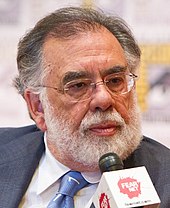
Coppola felt that the offset two films had told the complete Corleone saga. He intended Part Three to be an epilogue to the first ii films. A dire financial situation initially caused past the failure of One from the Centre (1982) compelled him to take upwards Paramount's offer to make a third installment.[4] [v] [half dozen] Coppola and Puzo preferred the title The Death of Michael Corleone, just Paramount Pictures establish that unacceptable.
Al Pacino, Diane Keaton, and Talia Shire reprised their roles from the first 2 films. According to Coppola's audio commentary on the flick in The Godfather DVD Drove, Robert Duvall refused to take function unless he was paid a salary comparable to Pacino's. In 2004, on the CBS program 60 Minutes, Duvall said, "if they paid Pacino twice what they paid me, that's fine, just non three or four times, which is what they did."[7] When Duvall dropped out, Coppola rewrote the screenplay to portray Tom Hagen as having died before the story begins and created the grapheme B. J. Harrison, played past George Hamilton, to replace the Hagen character in the story. Coppola stated that, to him, the picture show feels incomplete "without [Robert] Duvall's participation". According to Coppola, had Duvall agreed to take office in the picture, the Hagen grapheme would have been heavily involved in running the Corleone charities. Duvall confirmed in a 2010 interview that he never regretted the decision of turning down his office.[8]
The starting time draft of a script had been written by Dean Riesner in 1979, based on a story by Mario Puzo. This script centered around Michael Corleone'south son, Anthony, a naval officer working for the CIA, and the Corleone family's interest with a plot to electrocute a Fundamental American dictator.[ix] Almost none of the elements of this early script carried over to the final film, simply 1 scene from the picture – in which two men break into Vincent's house – exists in the Riesner draft and is nearly unchanged.[10]
Julia Roberts was originally cast every bit Mary but dropped out due to scheduling conflicts.[11] Madonna wanted to play the role, but Coppola felt she was likewise old for the part.[12] Rebecca Schaeffer was set to audition, simply her participation in the motion picture was cutting brusque by her murder by an obsessed fan.[thirteen] [14] Winona Ryder dropped out of the film at the last infinitesimal due to nervous burnout.[eleven] Ultimately, Sofia Coppola, the director's daughter, was given the role of Michael Corleone's daughter. Her much-criticized functioning resulted in her father being accused of nepotism, a charge Coppola denies in the commentary track, asserting that, in his opinion, critics, "showtime with an article in Vanity Fair," were "using [my] daughter to attack me," something he finds ironic in light of the film's denouement when Mary pays the ultimate cost for her father'due south sins.
As an infant, Sofia Coppola had played Michael Corleone's baby nephew in The Godfather, during the climactic baptism/murder montage at the cease of that moving-picture show (Sofia Coppola also appeared in The Godfather Part Ii, as a small immigrant child in the scene where the nine-year-quondam Vito Corleone arrives by steamer at Ellis Island). The graphic symbol of Michael'south sister Connie is played by Francis Ford Coppola's sister, Talia Shire. Other Coppola relatives with cameos in the film included the manager'due south female parent, father (who wrote and conducted much of the music in the motion picture), uncle, and granddaughter Gia.[15]
Chief photography was set to begin on Nov 15, 1989, simply the start date was pushed dorsum to November 27.[xvi] Filming continued throughout much of 1990.
Music [edit]
The film'south soundtrack received a Golden Globe Award nomination for All-time Score. The film's dear theme, "Promise Me You'll Remember" (subtitled "Dearest Theme from The Godfather Part Three") sung past Harry Connick, Jr., received Academy Award and Aureate Globe Laurels nominations for Best Song.
Al Martino, who portrayed Johnny Fontane in The Godfather and The Godfather Part III, sings "To Each His Own".
Release [edit]
The moving picture was distributed past Paramount Pictures, premiering in Beverly Hills on December xx, 1990 and released in the Usa on December 25.
Recut version (2020) [edit]
For the film's 30th anniversary, a recut version of the motion picture titled Mario Puzo's The Godfather, Coda: The Death of Michael Corleone had a express theatrical release on December four, 2020, followed by digital and Blu-ray releases on December eight. Coppola'southward recut includes changes to both the outset and the ending of the film and some re-edited scenes and musical cues. The total runtime of this recut version is 158 minutes compared to the original film'south 162 minutes.[17] [18]
Coppola said the recut film is the version that he and Puzo had originally envisioned and that it "vindicates" its status in The Godfather trilogy, as well as his girl Sofia's performance.[nineteen] Both Pacino and Keaton gave their approving to the recut film, noting information technology equally an improvement over the original film.[20]
Reception [edit]
Box part [edit]
The Godfather Office III grossed $66.vii million in the United States and Canada, and $70.1 million in other territories, for a worldwide total of $136.eight million, against a production upkeep of $54 1000000.[ii]
The film opened in 1,901 theaters, and grossed $19.6 1000000 in its opening weekend, finishing second behind Abode Lone.[21] In its 2d weekend information technology fabricated $8.three million, finishing 3rd.[22]
Upon the release of the recut version, Mario Puzo's The Godfather, Coda: The Expiry of Michael Corleone, in December 2020, it made $52,000 from 179 theaters.[23] In full, the moving-picture show made $95,000 domestically, and $71,000 in four international markets.[2]
Critical response [edit]
Original moving picture (1990) [edit]

Sofia Coppola in 2013; her functioning in the film was negatively received by critics.
Mutual criticisms of The Godfather Role Three focused on Sofia Coppola'southward acting, the convoluted plot, and the film'south inadequacy as a "stand-lone" story.[24] [25] On Rotten Tomatoes, the film holds an approving rating of 68% based on 63 reviews, with an boilerplate rating of 6.forty/10. The site'southward critical consensus reads: "The terminal installment of The Godfather saga recalls its predecessors' ability when information technology'southward strictly business, simply underwhelming performances and confused tonality brings less closure to the Corleone story."[26] Metacritic assigned the film a weighted average score of 60 out of 100, based on 19 critics, which indicates "mixed or boilerplate reviews".[27] Opening solar day audiences polled by CinemaScore gave the film an average grade of "B+" on an A+ to F calibration.[28]
In his review, Roger Ebert stated that it is "non even possible to understand this film without knowing the commencement two." Nonetheless, Ebert wrote an enthusiastic review, awarding the film three-and-a-one-half stars, a better rating than he originally gave The Godfather Part II [29] (in his 2008 re-rating, he gave The Godfather Part Ii four stars[30] and included it in his list of Cracking Movies). He likewise defended the casting of Sofia Coppola, who he felt was not miscast, stating, "There is no way to predict what kind of operation Francis Ford Coppola might have obtained from Winona Ryder, the experienced and talented immature actress, who was originally set to play this role. But I think Sofia Coppola brings a quality of her own to Mary Corleone. A certain upwards-front vulnerability and simplicity that I think are advisable and right for the role."
Ebert'south colleague, Cistron Siskel, also gave the picture high praise, and placed it tenth in his list of the x best films of 1990. Siskel admitted that the ending was the flick's weakest part, citing Al Pacino'south makeup every bit very poor. He also said, "[Another] problem is the casting of Sofia Coppola, who is out of her acting league here. She'southward supposed to be Andy Garcia'southward love involvement but no sparks fly. He'due south more like her babysitter." In response to Ebert's defense of Coppola, Siskel said: "I know what you lot're saying about her being sort of natural and not the polished bombshell, and that would've been wrong. There is ane, a photographer in the picture, who takes care of that function, but at the same time, I don't think it's explained why [Vincent] actually comes onto her, unless this guy is the most venal, craven guy, merely look who he'southward playing around with. He's playing around with the Godfather'south daughter."
Leonard Maltin, giving the movie three out of 4 stars, stated that the picture show is "masterfully told", only that casting Sofia Coppola was an "about-fatal flaw."[31] John Simon of the National Review described the picture as "a tedious effort to flog an old hippopotamus into action".[32]
Recut version (2020) [edit]
On Rotten Tomatoes, the recut version, Mario Puzo'southward The Godfather, Coda: The Death of Michael Corleone, holds an approving rating of 87% based on 55 reviews, with an boilerplate rating of 7.sixty/10. The website's critics consensus reads: "The Godfather, Coda: The Death of Michael Corleone pulls the audience back into Francis Ford Coppola's epic gangster saga with a freshly — albeit slightly — edited version of its final installment."[33] On Metacritic, the picture show was assigned a weighted average score of 76 out of 100, based on 14 reviews, indicating "more often than not favorable reviews".[34]
Writing for The Guardian, Peter Bradshaw gave the motion-picture show 3 out of 5 stars and stated, "I'yard not sure how much, if anything, Coppola'due south re-edit does for the motion-picture show, but it's worth a watch."[18] Owen Gleiberman of Variety stated, "Hither's the news and the e'er-and so-slight scandal: It's the same damn movie. I'thousand non exaggerating; it really is. The i impactful modify is the new opening scene."[35] Writing for IndieWire, David Ehrlich said, "Simply when it was announced that [Coppola] had inevitably assembled a new cut of his most famous crusade célèbre and re-christened information technology with the title he'd ever wanted for the motion picture... he wasn't trying to make it 'better' then much as he was trying to shift its place in history and reframe the picture as less the 3rd part of a flawed trilogy than the postscript of a legendary dyad."[36]
Accolades [edit]
Although reception to the pic was mixed, the film was nominated for seven Academy Awards including Best Moving picture, All-time Manager, Best Thespian in a Supporting Role (Andy García), Best Cinematography, Best Moving-picture show Editing, All-time Art Direction-Gear up Ornamentation (Dean Tavoularis, Gary Fettis), All-time Music, Song (for Red Coppola and John Bettis for "Hope Me You'll Remember").[37] [38] It is the merely film in the series not to take Al Pacino nominated for an Academy Laurels (he was nominated for Best Supporting Player for The Godfather and for Best Actor for The Godfather Role II). Information technology is the but film in the trilogy not to win for All-time Motion picture or any other Academy Accolade for that matter, also as the only movie in the trilogy not selected for preservation past the U.S. National Film Registry. Along with The Lord of the Rings, The Godfather Trilogy shares the stardom that all of its installments were nominated for Best Picture.
The moving picture was likewise nominated for seven Golden Globes Awards, simply did not win.[39] Sofia Coppola won two Golden Raspberry Awards for both Worst Supporting Actress and Worst New Star.
| Honor | Category | Nominee | Result |
|---|---|---|---|
| 63rd Academy Awards | Best Picture | Francis Ford Coppola | Nominated |
| All-time Director | Nominated | ||
| All-time Player in a Supporting Role | Andy García | Nominated | |
| Best Art Direction | Dean Tavoularis and Gary Fettis | Nominated | |
| Best Cinematography | Gordon Willis | Nominated | |
| All-time Film Editing | Barry Malkin, Lisa Fruchtman, and Walter Murch | Nominated | |
| Best Original Song | "Promise Me You lot'll Recollect" (music by Carmine Coppola; lyrics by John Bettis) | Nominated | |
| 43rd Directors Club of America Awards | Outstanding Directorial Achievement in Motion Pictures | Francis Ford Coppola | Nominated |
| 48th Gilded Globe Awards | Best Motion Picture – Drama | Nominated | |
| Best Director – Motion Picture | Francis Ford Coppola | Nominated | |
| Best Actor – Picture Drama | Al Pacino | Nominated | |
| All-time Supporting Role player – Motility Picture | Andy García | Nominated | |
| Best Screenplay | Francis Ford Coppola and Mario Puzo | Nominated | |
| All-time Original Score | Carmine Coppola | Nominated | |
| Best Original Song | "Promise Me You'll Call up" (music by Ruby-red Coppola; lyrics by John Bettis) | Nominated | |
| 11th Gilded Raspberry Awards | Worst Supporting Actress | Sofia Coppola | Won |
| Worst New Star | Won | ||
The film is recognized past American Film Institute in these lists:
- 2005: AFI'due south 100 Years...100 Movie Quotes:
- Michael Corleone: "But when I thought I was out, they pull me back in." – Nominated[twoscore]
Historical background [edit]
Parts of the flick are very loosely based on existent historical events apropos the catastrophe of the papacy of Pope Paul VI, the very short tenure of Pope John Paul I in 1978, and the collapse of the Banco Ambrosiano in 1982. Similar the grapheme Primal Lamberto, who becomes John Paul I, the historical John Paul I, Albino Luciani, reigned for only a very short time before being found dead in his bed.
Journalist David Yallop argues that Luciani was planning a reform of Vatican finances and that he died past poisoning; these claims are reflected in the film.[41] Yallop besides names as a suspect Archbishop Paul Marcinkus, who was the caput of the Vatican bank, like the graphic symbol Archbishop Gilday in the pic. However, while Marcinkus was noted for his muscular physique and Chicago origins, Gilday is a mild Irishman. The character has also fatigued comparisons to Cardinal Giuseppe Caprio, every bit he was in accuse of the Vatican finances during the guess period in which the flick was based.[42]
The graphic symbol of Frederick Keinszig, the Swiss banker who is murdered and left hanging under a bridge, mirrors the fate (and physical appearance) of Roberto Calvi, the Italian head of the Banco Ambrosiano who was found hanging under Blackfriars Bridge in London in 1982 (it was unclear whether it was suicide or murder; courts in Italy have recently[ when? ] ruled the latter). The proper name "Keinszig" is taken from Manuela Kleinszig, the girlfriend of Flavio Carbone, who was indicted as i of Calvi'southward murderers in 2005.[43]
Cancelled sequel [edit]
Following the reaction to the third installment, Coppola stated that the idea of a fourth film was discussed but Mario Puzo died before they were able to write it. A potential script, told in a similar narrative to Part 2, would accept included De Niro reprising his role as a younger Vito Corleone in the 1930s; Leonardo DiCaprio was slated to portray a young Sonny Corleone gaining the Corleone family's political power;[44] García equally Vincent Corleone during the 1980s running the family unit business concern through ten years of destructive state of war, haunted by the death of his cousin Mary, and eventually losing the family'southward respect and power.[45] García has since claimed the motion picture's script was nearly produced.[45]
Puzo's portion of the potential sequel, dealing with the Corleone family in the early 1930s, was eventually expanded into a novel by Edward Falco and published in 2012 as The Family Corleone.[46] [47] Paramount sued the Puzo estate to prevent publication of the novel, prompting a counter-suit on the function of the estate claiming alienation of contract. The studio and the estate later settled the suits, allowing publication of the book, but with the studio retaining rights to possible futurity films.[48]
References [edit]
- ^ "THE GODFATHER PART 3". British Board of Motion-picture show Classification. Archived from the original on February 28, 2018. Retrieved February 19, 2018. Approved Running time: 161m 33s
- ^ a b c d "The Godfather Part III (1990)". Box Office Mojo. Archived from the original on Baronial five, 2013. Retrieved August xvi, 2013.
- ^ Connor, J. D. (April 8, 2015). The Studios after the Studios: Neoclassical Hollywood (1970-2010). Stanford, California: Stanford University Printing. p. 89. ISBN978-0-8047-9474-9.
- ^ Collins, Andrew (June 27, 1999). "Don't practise information technology Francis". The Guardian . Retrieved December 20, 2020.
- ^ Schwartz, Niles (March 28, 2018). ""Time, Who Eats His Own Young": Coppola, Corleone, and Catiline in "Megalopolis"". mspcinephiles.org . Retrieved December 20, 2020.
- ^ "Coppola Files for Bankruptcy". The New York Times. July 2, 1992. Retrieved December 20, 2020.
- ^ Leung, Rebecca (January 6, 2004). "Robert Duvall Does The Tango". CBS News. Archived from the original on Dec 28, 2019. Retrieved Dec 28, 2019.
- ^ Galloway, Stephen; Belloni, Matthew (December 20, 2010). "Nearing 80, Robert Duvall hits awards-season trail". Reuters . Retrieved Nov 6, 2015.
- ^ "The Godfather Part III (1979 script)" (PDF). AwesomeFilm.com. Archived (PDF) from the original on Oct 7, 2009. Retrieved March iv, 2010.
- ^ "The Godfather Part III (1979 script), pp 53–57" (PDF). AwesomeFilm.com. Archived (PDF) from the original on October 7, 2009. Retrieved March 4, 2010.
- ^ a b "Death in the family". The Guardian. April 15, 2000. Archived from the original on March 24, 2014. Retrieved August 22, 2013.
- ^ Nick Browne, ed. (2000). Francis Ford Coppola's The Godfather Trilogy. Cambridge University Press. p. 48. ISBN9780521559508.
- ^ Ojumu, Akin (February xvi, 2003). "Brad Silbering: The family that grieves together..." The Observer. Archived from the original on April ii, 2017. Retrieved August 22, 2013.
- ^ "Expiry on Main Street". The Age. March eight, 2003. Archived from the original on Oct 22, 2012. Retrieved Apr 16, 2020.
- ^ "Coppola Family Cameos". Destination Hollywood. Archived from the original on October 29, 2013. Retrieved Baronial 22, 2013.
- ^ THE GODFATHER Role Iii AFI Catalog
- ^ "Francis Ford Coppola Recutting 'Godfather: Office Three' For 30th Anniversary". hollywoodreporter.com. September iii, 2020. Archived from the original on September 4, 2020. Retrieved September iii, 2020.
- ^ a b Peter Bradshaw (Dec one, 2020). "The Godfather Coda: The Death of Michael Corleone review – Coppola edits the past". The Guardian . Retrieved Dec 5, 2020.
- ^ Ryan Parker (December 3, 2020). "Francis Ford Coppola Says 'Godfather: Function III' Recut Vindicates Film, Girl Sofia". The Hollywood Reporter. Retrieved December iii, 2020.
- ^ Charles Barfield (Dec v, 2020). "Al Pacino "Breathed A Sigh Of Relief" After Seeing Opening Scene Of 'Godfather Function III' Re-Edit". The Playlist. Retrieved December 5, 2020.
- ^ "The Godfather: Part III (1990)". numbers.com. Archived from the original on September iv, 2020. Retrieved December 28, 2019.
- ^ Domestic 1991 Weekend 1 - Box Part Mojo
- ^ Brueggemann, Tom (December 6, 2020). "'Croods' and 'Half-Brothers' Lead Universal-Dominated Box Office Weekend to Less Than $9 Million". IndieWire . Retrieved December 6, 2020.
- ^ New York Times Archived March 8, 2013, at the Wayback Machine Retrieved March 2009; The Godfather Part Iii (1990)
- ^ Kakutani, Michiko (November 12, 2004). "You Think You're Out, but They Endeavour to Pull You Back In". The New York Times. Archived from the original on May 28, 2015. Retrieved August 22, 2013.
- ^ "The Godfather, Function Iii (1990)". Rotten Tomatoes. Fandango. Archived from the original on May 17, 2019. Retrieved December three, 2020.
- ^ "The Godfather: Office 3 Reviews". Metacritic. Archived from the original on July 27, 2010. Retrieved August x, 2011.
- ^ "Find CinemaScore" (Type "Godfather" in the search box). CinemaScore. Archived from the original on January ii, 2018. Retrieved April 4, 2020.
- ^ Ebert, Roger (December 25, 1990). "The Godfather, Office III Motion picture Review (1990)". Archived from the original on October 29, 2013. Retrieved Baronial 22, 2013.
- ^ Roger Ebert: Review of The Godfather, Part Ii (1974) Archived May 9, 2017, at the Wayback Machine, Oct 2, 2008.
- ^ Maltin, Leonard (2009). Leonard Maltin's 2009 Movie Guide. New York Urban center: Penguin Grouping. p. 530. ISBN978-0-452-28978-9.
- ^ Simon, John (2005). John Simon on Film: Criticism 1982-2001. Applause Books. p. 197.
- ^ "THE GODFATHER, Coda: The Decease of Michael Corleone (2020)". Rotten Tomatoes. Fandango. Retrieved February 7, 2021.
- ^ "The Godfather Coda: The Death of Michael Corleone Reviews". Metacritic. Red Ventures. Retrieved Dec 18, 2020.
- ^ Owen Gleiberman (December 4, 2020). "'The Godfather, Coda: The Death of Michael Corleone' Is a Chance to Revisit a Film That Didn't Deserve Its Brickbats". Variety. Retrieved December five, 2020.
- ^ Ehrlich, David (December 10, 2020). "How 'The Godfather Coda' Allows Francis Ford Coppola to Redefine His Biggest Disappointment". IndieWire . Retrieved Dec ten, 2020.
- ^ "The 63rd Academy Awards (1991) Nominees and Winners". oscars.org. Archived from the original on April 2, 2015. Retrieved August 2, 2011.
- ^ "Sooner or Later on" Wins Original Song: 1991 Oscars
- ^ The Godfather Part III, seven Nomination(south) | 0 Win(s) | 1991 Archived July 12, 2010, at the Wayback Machine
- ^ "AFI's 100 Years...100 Moving picture Quotes Nominees" (PDF). Archived (PDF) from the original on June 24, 2016. Retrieved July 30, 2016.
- ^ Vankin, Jonathan; Whalen, John (2004). The 80 Greatest Conspiracies of All Time: History's Biggest Mysteries, Coverups, and Cabals. New York City: Citadel Press. pp. 172–174. ISBN0-8065-2531-2.
- ^ Vankin & Whalen, pp. 178–179
- ^ Banakas, Efstathios One thousand. (1996). Civil Liability for Pure Economic Loss: Proceedings of the Almanac International Colloquium of the United kingdom National, Committee of Comparative Law Held in Norwich, September, 1994. Philadelphia: Kluwer Police force International. ISBN978-90-411-0908-eight.
- ^ "DiCaprio and Garcia set to star in The Godfather part IV | Picture". The Guardian. Archived from the original on Nov 8, 2016. Retrieved November viii, 2016.
- ^ a b Morris, Andy (March 16, 2011). "The Godfather Part 4". GQ. Archived from the original on September 4, 2015. Retrieved August 27, 2015.
- ^ Wilson, Craig (May 6, 2012). "Prequel lays out life before 'The Godfather'". USA Today. Archived from the original on February v, 2013. Retrieved April 12, 2015.
- ^ Schulder, Michael (September 4, 2012). "CNN Profiles: Ed Falco'south prequel to 'The Godfather'". CNN Radio. Archived from the original on September 9, 2012. Retrieved October ii, 2012.
- ^ Patten, Dominic (Dec 21, 2012). "Paramount & Puzo Estate Settle 'Godfather' Adjust". Deadline. Archived from the original on March 4, 2013. Retrieved November eight, 2016.
Sources [edit]
- Coppola, Francis Ford. "Director'due south Commentary rails". The Godfather Role 3 DVD. Included in The Godfather DVD Drove.
- Cornwell, Rupert (1984). God's Broker: The Life and Death of Roberto Calvi. Victor Gollancz Ltd.
- Yallop, David (1987). In God's Proper noun: An Investigation into the Murder of Pope John Paul I. Corgi.
External links [edit]
Source: https://en.wikipedia.org/wiki/The_Godfather_Part_III

Post a Comment for "When Will the Godfather 111 Be on Tv Again"